
"Objection Sustained": Relevance Rules the Court!
What's a Tuesday without a Courtroom Drama


“Objection, My Lord… But Relevant to What?”
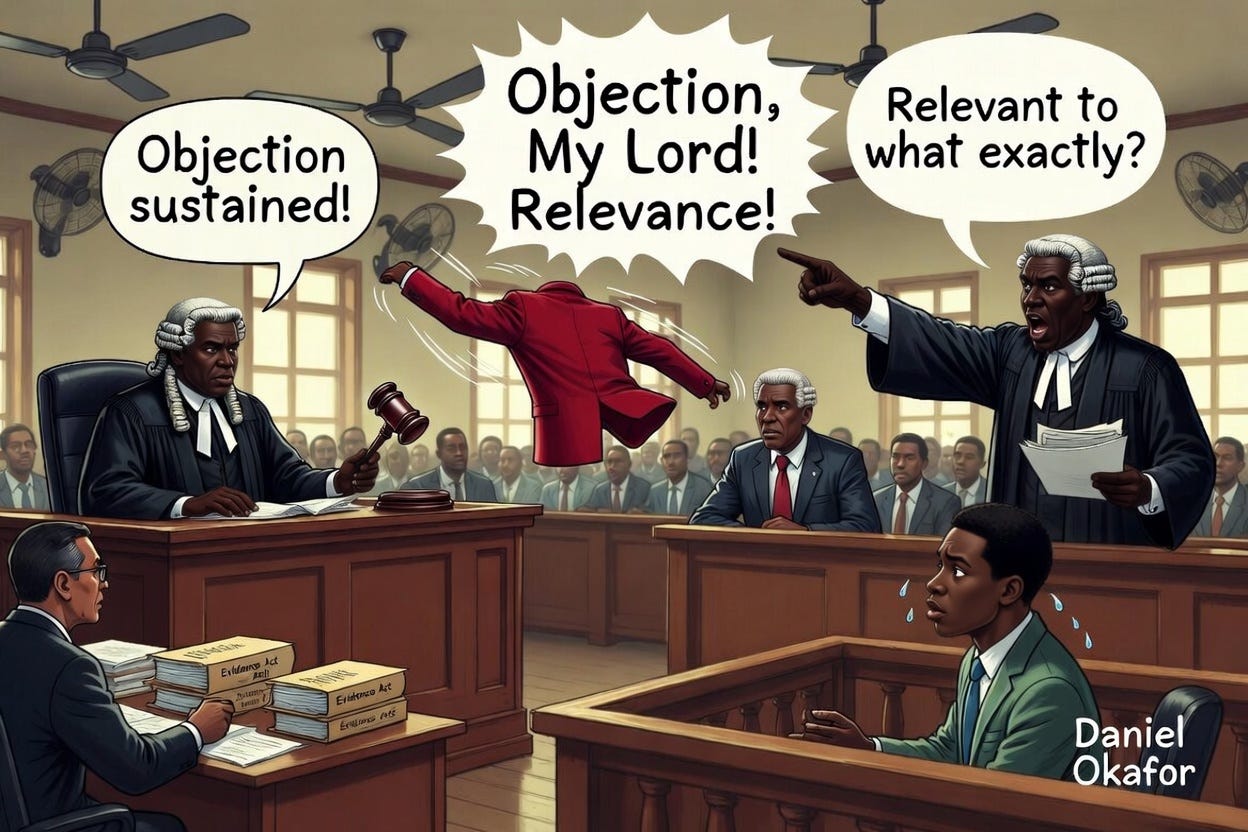
The courtroom carried the usual Lagos heat.
Not the weather.
The tension.
People shifted on wooden benches while the court clerk arranged files with the kind of seriousness that could intimidate even innocence itself.
The matter before the court was simple on paper.
State v. Daniel Okafor.
Armed robbery.
But like most matters in court, simplicity had already packed its bags and left before proceedings even began.
The prosecution alleged that Daniel had attacked one Mr. Adeyemi around 9:15 pm beside a fuel station in Surulere and escaped with his phone and wristwatch.
Daniel denied everything.
And now, both truth and strategy stood before the court pretending not to know each other.
COURT CLERK:
“All rise!”
The courtroom rose as the judge entered.
JUDGE:
“Be seated.”
A few seconds of silence followed.
The dangerous type.
The prosecution counsel stood first.
PROSECUTION OPENS
PROSECUTION COUNSEL:
“My Lord, the prosecution calls its first witness — Mr. Tunde Adeyemi.”
A middle-aged man stepped into the witness box, adjusted his glasses nervously, and took the oath.
PROSECUTION COUNSEL:
“Mr. Adeyemi, kindly tell this honourable court what happened on the night of March 12.”
WITNESS:
“I was returning from work when someone pointed a gun at me near the filling station. He collected my phone and watch.”
PROSECUTION COUNSEL:
“Can you identify the person?”
The witness pointed immediately.
WITNESS:
“It was him. The defendant.”
Murmurs escaped from the gallery.
Daniel looked away slowly.
THE FIRST OBJECTION
PROSECUTION COUNSEL:
“My Lord, after the robbery, the defendant was arrested and a red jacket was recovered from his apartment.”
He lifted the jacket dramatically.
Courtroom theatrics.
Every lawyer’s silent hobby.
PROSECUTION COUNSEL:
“This is the jacket he wore during the robbery.”
DEFENCE COUNSEL:
“Objection, My Lord!”
The courtroom straightened instantly.
Even people who did not understand law loved objections.
JUDGE:
“Grounds?”
DEFENCE COUNSEL:
“My Lord, relevance. By virtue of Sections 1 and 2 of the Evidence Act 2011, evidence must relate to a fact in issue or a relevant fact to be admissible under the law.”
He walked slowly. Carefully.
“The prosecution has not laid any foundation connecting that jacket to the alleged offence.”
He paused.
“The witness never mentioned any red jacket in his evidence. No identifying mark. No forensic link. Nothing.”
Another pause.
“Sections 4 to 13 of the Evidence Act provides grounds necessary for gauging the relevance of an evidence, and even an undergraduate law student can smell the irrelevance of this evidence from the courtyard”
He adjusted his wig slightly.
“Evidence does not become admissible simply because counsel is emotionally attached to it.”
Small laughter escaped from the courtroom.
The prosecution frowned.
PROSECUTION COUNSEL:
“My Lord, the evidence is relevant because it was recovered from the defendant’s house during investigation.”
DEFENCE COUNSEL:
“Relevant to what exactly?”
Silence.
That question landed heavily.
He continued.
“My Lord, under Sections 2 of the Evidence Act, relevance is the gateway to admissibility. Before evidence enters this courtroom, it must logically connect to a fact in issue and be admissible under the tenets of the legislations”
He turned slightly toward the judge.
“If every random item recovered from an accused person’s house becomes admissible merely because police found it there, then every Nigerian mother’s kitchen knife may soon become Exhibit A in murder trials.”
The gallery burst into laughter again.
Even the judge almost smiled.
Almost.
THE COURT RULES
The judge adjusted his glasses.
JUDGE:
“The court agrees that relevancy determines admissibility.”
He looked at the prosecution.
“The witness did not describe the attacker’s clothing, neither has any nexus been established between this jacket and the robbery.”
A pause.
“Sections 1 and 2 of the Evidence Act are clear that irrelevant facts-even facts relevant but too remote, are inadmissible.”
Another pause.
“This court is not a storage room for investigative guesses.”
Another pause.
“Objection sustained. The jacket is rejected.”
The defence sat down slowly.
Satisfied.
Not because they had won.
But because they had prevented bad evidence from pretending to be good evidence.
THE SECOND ATTEMPT
The prosecution stood again.
This time more careful.
PROSECUTION COUNSEL:
“My Lord, the prosecution tenders the defendant’s phone call records showing communication between the defendant and one Chibuzor, a known robbery suspect.”
DEFENCE COUNSEL:
“Objection, My Lord!”
The judge sighed softly.
He already knew this was going to be one of those days.
JUDGE:
“Grounds?”
DEFENCE COUNSEL:
“My Lord, counsel is attempting to poison the mind of the court.”
He faced the judge.
“The mere fact that someone spoke with another alleged criminal does not prove participation in robbery.”
PROSECUTION COUNSEL:
“My Lord, we are not tendering it to prove guilt directly. We tender it to establish association and communication shortly before the incident. By virtue of Section 4 of the Evidence Act, facts which are connected to a fact in issue as to form part or the same transaction are relevant or facts which support or rebut an inference by a fact in issue or relevant fact which make its existence probable are relevant by virtue of Section 7 EA.”
The judge leaned back thoughtfully.
And this was where law became dangerous.
Because evidence did not always need to prove everything.
Sometimes, it only needed to make another fact more probable.
JUDGE:
“Counsel for the defence is correct that association alone does not establish guilt.”
The defence nodded confidently.
But the judge continued.
“However, admissibility is not determined by whether evidence conclusively proves a case.”
Now the prosecution nodded confidently.
“Under Sections 1 and 2 of the Evidence Act, evidence is admissible once it is relevant to a fact in issue or relevant fact.”
The judge looked at both counsel.
“The weight to be attached to it is another matter entirely.”
That sentence entered the courtroom like a lecturer entering an exam hall unexpectedly.
Everyone adjusted mentally.
JUDGE:
“The objection is overruled. The call records are admitted.”
DEFENCE STRIKES BACK
The defence counsel rose for cross-examination.
Calmly.
Too calmly.
Which usually meant trouble was coming.
DEFENCE COUNSEL:
“Mr. Adeyemi, how long did the robbery last?”
WITNESS:
“Maybe thirty seconds.”
DEFENCE COUNSEL:
“At night?”
WITNESS:
“Yes.”
DEFENCE COUNSEL:
“You were frightened?”
WITNESS:
“Very frightened.”
DEFENCE COUNSEL:
“And yet, within thirty seconds, in darkness, while staring at a gun… you perfectly identified the defendant?”
The witness hesitated.
Just briefly.
But in court, hesitation speaks loudly.
The defence moved closer.
DEFENCE COUNSEL:
“My Lord, no further questions.”
THE FINAL MOMENT
Closing addresses arrived.
The prosecution relied on identification and surrounding circumstances.
The defence attacked reliability.
Attacked procedure.
Attacked relevance.
Then finally—
The judge delivered ruling.
JUDGE:
“This court must emphasize that not all evidence brought before a court is admissible.”
He continued.
“By virtue of Sections 1, 2 including 4-13 of the Evidence Act 2011, the law first asks whether evidence is relevant. If irrelevant, it is inadmissible regardless of how dramatic or suspicious it appears.”
A pause followed.
“However, once evidence is relevant under the Evidence Act, it generally becomes admissible unless excluded by another rule of law.”
The courtroom remained silent.
Because everyone there understood something now.
Law was not merely about what happened.
It was about what could properly be proved.
And in court…
Facts do not walk in freely.
They must enter through the door called relevance.
Your Legal Dramatist,
Akalonu Chinwekene Andrea 😉
(GLOBAL WRITER)
 | A guest post by
|